
Posted on January 13, 2026 by Katelyn Juarez
A pair of COEHD faculty members are contributing to statewide efforts to address educational workforce challenges through their selection to the LonestaRP3 Teacher Workforce Strategy Team.
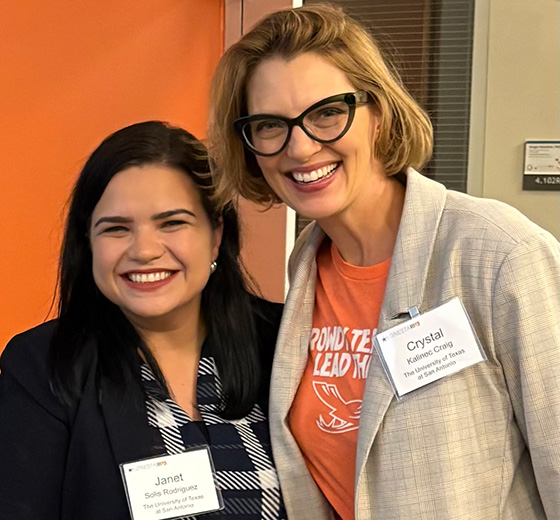
Janet Solis Rodriguez and Crystal Kalinec-Craig at the LonestaRP3 Teacher Workforce Strategy event.
Two University of Texas at San Antonio faculty members in the College of Education and Human Development were selected to serve on the LonestaRP3 Teacher Workforce Strategy team, bringing critical local perspectives to a statewide initiative addressing educational workforce challenges.
LonestaRP3 is a statewide network that brings together researchers, practitioners and policy advocates to make promising research easy to find, understand and use while reforming policy and transforming education systems. The organization represents a comprehensive approach to understanding and addressing the complex ecosystem of teaching in Texas.
Janet Solis Rodriguez, assistant professor in the Department of Educational Leadership and Policy Studies, and Crystal Kalinec-Craig, professor in the Department of Interdisciplinary Learning and Teaching were selected as part of the strategically assembled team that brought together researchers, practitioner and policy advocates. These representatives came from the Texas Education Agency, public and private universities, policy organizations, and school districts across Texas, ensuring a comprehensive view of challenges affecting the teacher workforce.
During the day-long strategic meeting at The University of Texas at Austin’s College of Education, participants engaged in intensive breakout session designed to develop targeted research frameworks.
The team’s focus areas were targeting teacher recruitment, retention and preparation. Kalinec-Craig was passionate about highlighting barriers that educators face today. “The state and the agency make it almost untenable for our teacher candidates to enter the workforce and be certified because of the numerous hoops they need to jump through,” she explained. “This is especially challenging for bilingual educators, who face additional testing requirements that create significant obstacles for certification.”
Solis Rodriguez emphasized the unique approach of the team’s research initiative, highlighting its commitment to immediate and practical impact. “We know the literature really well,” Solis Rodriguez explained. “It adds a different layer of complexity and immediacy to hear practitioners talk about their experiences on the ground and how we can help them right now, not just years from now, as they navigate different challenges affecting the teacher workforce, which have large implications for teaching and learning in their schools.”
“We want to understand not just whether teachers are staying in schools and how we can support their retention,” Solis Rodriguez explained. “But also how we can support highly effective teachers in mentoring others and entering leadership roles, like the principalship.”
Solis Rodriguez, Kalinec-Craig and the college’s Urban Education Institute, led by Sharon Nichols, will continue this collaboration with LonestaRP3 with an upcoming event in February at Texas Tech University. The team will build relationships, raise awareness of pressing issues affecting Texas schools and workforce, and help generate and translate research into accessible and actionable solutions for policy and practice.
The team’s work is particularly urgent with increasing teacher shortages, complex certification processes and systemic challenges. Kalinec-Craig said it best, “We here in San Antonio represent everyone, and we were at least there to remind everybody of our humanity,” she said. “When we look at charts, graphs and numbers, those are human beings behind that.”
— Katelyn Juarez
