
About ATE
The Academy for Teacher Excellence Research Center (ATE) in the College of Education and Human Development (COEHD) at UT San Antonio, the premier higher education institution in South Texas, has been sustained by numerous grants received from federal, state, and private funding agencies throughout its inception.
ATE is grounded in the Culturally Efficacious Evolution Model (CEEM) and serves as a center for research, design, evaluation, program implementation, and collaboration for school districts, community colleges, the private sector, and UT San Antonio. ATE leverages institutional and community resources to holistically prepare teacher candidates and in-service teachers who work with all student populations in our community.
Mission
Recognizing that The University of Texas at San Antonio is the premier institution for higher education in South Texas, ATE’s mission is to collaborate with community colleges, community agencies, and school districts by:
- Supporting Latino/Hispanic and other ethnically diverse students as they overcome financial, psycho-social, and institutional barriers. These obstacles have traditionally hindered their full participation in higher education.
- Increasing the sensitivity and preparation of faculty to address students' needs through culturally relevant curricula and instruction.
- Increasing the number of UT San Antonio teacher certification programs that become nationally recognized for success in addressing culturally and linguistically diverse student populations.
- Conducting quantitative and qualitative research that informs administrators, teachers, university faculty, and community members of research-based instructional practices.
- Creating accountable partnerships among schools, the community, and the university that prepare all students for the 21st Century.
Culturally Efficacious Evolution Model
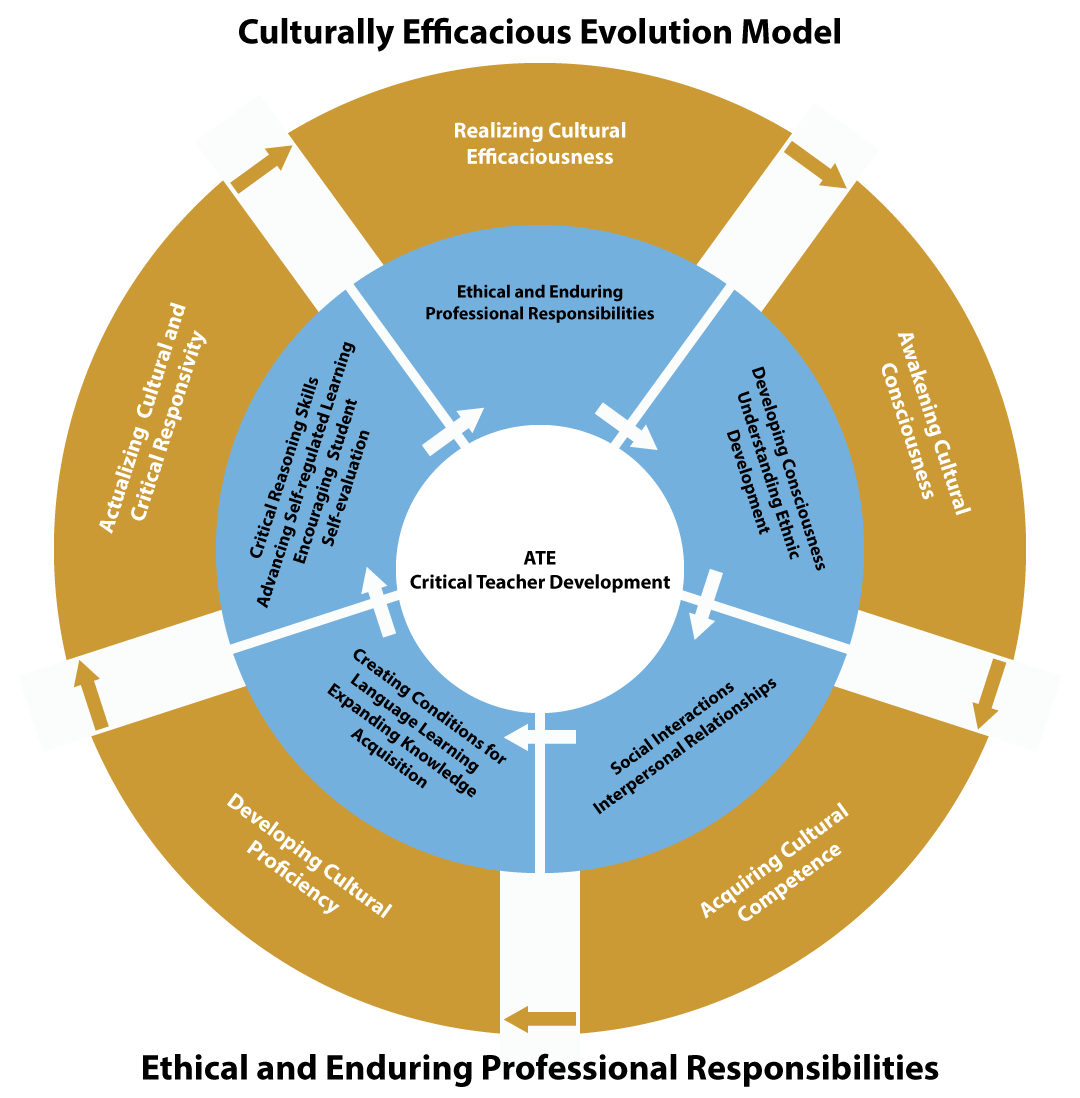 In 2010, Dr. Belinda Bustos Flores and other scholars and educators in the Academy for Teacher Excellence (2010) developed the Culturally Efficacious Evolution Model (CEEM) situating it in a socioconstructivist transformative framework (Vygotsky, 1987; Freire, 1983) to strengthen the teacher preparation program.
The teacher preparation program, which includes recruitment, preparation, and retention of teachers, who have the propensity to be social justice driven, draws on the literature from minority teacher recruitment (Flores et al., 2007; Villegas & Levine 2010); teacher knowledge models (Shulman, 1987, 2000; Saracho & Spodek, 1995; Darling-Hammond, 2006), and teacher induction (Achinstein & Athanases, 2007; Flores, Hernández, García, & Claeys, 2011). The literature that addresses teachers’ personal development, e.g. identity, efficacy, beliefs, dispositions, and positionality (Flores & Clark, 2017; Villegas & Lucas 2002b) also informs the CEEM.
The Culturally Efficacious Observation Protocol (CEOP) is a tool that assists in assessing teacher practices and student engagement using a sociocultural transformative framework, informed by Sheets’ (2005) diversity pedagogy, Darder’s (1997) critical pedagogy, and Flores, Sheets and Clark’s (2011) bilingual/bicultural critical pedagogy. This instrument was designed to assist the educator in their journey towards cultural efficaciousness. In designing the CEOP, the developers aligned the strands with the Culturally Efficacious Evolution Model as captured by Figure 1 (Flores, Claeys, & Gist, in Press). To ensure the validity of the CEOP, external experts examined the instrument, strands, and attributes. In addition, induction mentors conducting observations also provided critical feedback.
References
Darder, A. (1997). Creating the conditions for cultural democracy in the classroom. In A. Darder, R. Torres, & H. Gutiérrez (Eds.), Latinas and education: A critical reader (pp. 331-350). New York, NY: Routledge.
Flores, B. B., Sheets, R. H., & Clark, E. R. (Eds.). (2011). Teacher preparation for bilingual student populations: Educar para transformar. New York, NY: Routledge.
Sheets, R. H. (2005). Diversity pedagogy: Examining the role of culture in the teaching-learning process. Boston, MA: Pearson College Division.
Recognition
The White House Initiative on Educational Excellence for Hispanics encourages the amplification of the Bright Spots in Hispanic Education. The initiative seeks to leverage these Bright Spots to encourage collaboration between stakeholders focused on similar issues in sharing data-driven approaches, promising practices, peer advice, and effective partnerships, ultimately resulting in increased support for the educational attainment of the Hispanic community. It was announced in September 2015 that ATE would be included in the Bright Spot online catalog.
In October 2014, the White House Initiative on Educational Excellence for Hispanics launched a Year of Action, and with it a national call for Commitment to Action in honor of its 25 th anniversary. The Initiative challenged the public and private sectors to make meaningful and quantifiable contributions to expand and support the educational outcomes and opportunities for the Latino community. On October 15, 2015, President Obama announced 150 Commitments to Action programs. ATE answered the call and is featured among the Commitments to Action, committing over $500,000 to focus on Professional Development and Outreach through the annual Summer Bridging Institute (SBI). ATE makes a commitment to annually host the free, weeklong SBI for teacher candidates, novice teachers, and interested educators in an effort to recruit, support, and provide ongoing professional development to Latina/o teachers in our community.
¡Excelencia! held their 2012 Compendium in Washington D.C. to acknowledge and honor programs and departments that successfully serve Latino students. Of the 500 programs that have been nominated since 2005, over 100 have been chosen as outstanding models and resources for higher education success and contributions to continued research and education policy. ATE was honored as an Example of ¡Excelencia! Finalist at the Baccalaureate level in 2012. 159 programs were nominated with 16 finalists chosen. ¡Excelencia! in Education honored ATE’s efforts in Latino students’ financial concerns, educator preparation, informed quantitative and qualitative research and creating functional relationships between community, schools, and higher education institutions.
ATE was honored with 33 other UTSA faculty and staff at the 2012 University Excellence Awards to receive the President’s Distinguished Diversity Award.

The 2015 American Education Research Association-Hispanic Research Issues SIG Elementary, Secondary, and Postsecondary Award
The Texas Association for Bilingual Education (TABE) 2012 Higher Education Award
TABE 2012 Higher Education Honoree by the Texas Association for Bilingual Education.
Inducted into the San Antonio Women’s Hall of Fame in 2012
Congratulations Dr. Ellen Riojas Clark! A highly deserved recognition for one of the founding members of this AERA SIG, and a credit to UTSA COEHD!
Publications
ATE provides opportunities to faculty and graduate students to conduct quantitative and qualitative research that informs administrators, teachers, university faculty, and community members with research-based practices.
ATE Research Objectives include:
- Studies around issues affecting culturally and linguistically diverse (CLD) students, and the quality of education that they receive.
- Faculty development opportunities to enhance their instruction for a CLD student population through revised course syllabi and teaching methods;
- Academic preparation of Hispanic/Latina/o and low-income students to pursue an education degree and teacher certification particularly in bilingual education, special education, mathematics, and science instruction;
- Opportunities to learn and seek ways of becoming more effective in guiding, retaining, and graduating CLD and low-income students;
- Linkages with community colleges and school districts to create a seamless system of education that is culturally and linguistically sensitive to a diverse student population.
Over the years ATE has provided funding opportunities for faculty members at UTSA to engage in research activities with colleagues and graduate students across departments and colleges. Research awards support projects designed to provide new insights and solutions to problems and issues associated with the education and retention of P-20 Latin@/Hispanic and low-income students.
View publications here affiliated with the Academy for Teacher Excellence Research Center.
View news stories here about the Academy for Teacher Excellence Research Center.
Contact Us
Downtown Campus
Durango Building, Room 2.218
(210) 458-6170
ate@utsa.edu
